Essay · March 7, 2026
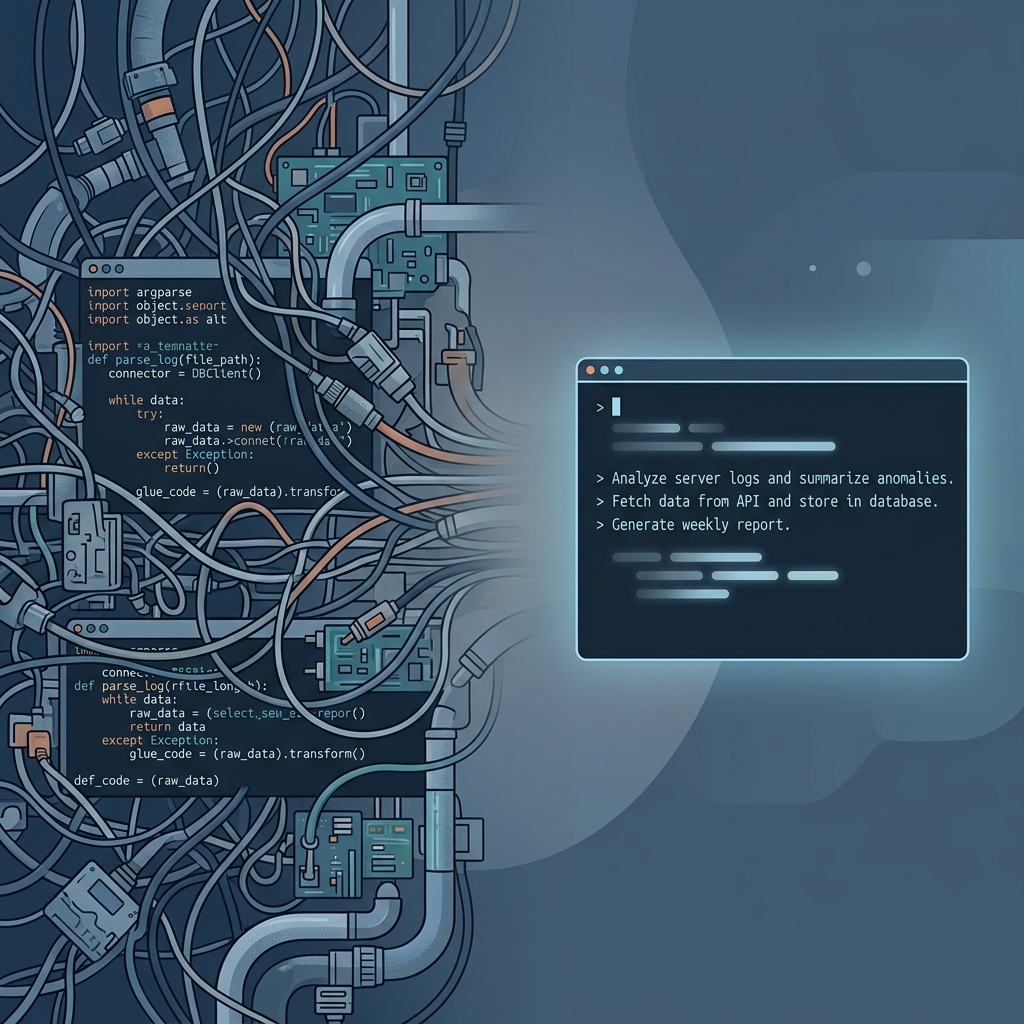
The model is rarely the bottleneck. The expensive part of applied ML is usually everything wrapped around the model: messy inputs, brittle integrations, awkward distribution, and the operational burden of keeping the whole thing alive.
The recurring example is a customer feedback classifier. On paper, this sounds like a solved problem: take customer comments, assign a category, produce a weekly summary. In practice, the classifier is the least interesting part of the system. The hard part is the parade of ugly interfaces that feed it.
Every week the data arrives in a different shape. Sometimes it is an Excel export. Sometimes it is a copy-paste from a spreadsheet into a chat box. Sometimes the rows are shifted because one cell contained a line break. Sometimes the categories live in Jira. Sometimes the customer context sits in Slack. Sometimes the only artifact anyone can hand you is a screenshot of JSON from an internal dashboard.
Tabs, uneven spacing, multiline cells, and columns that drift when the export changes.
Form output that still needs to be stripped down and reconstructed into rows and fields.
Threads for context and tickets for labels, each with their own auth, pagination, and failure modes.
The data exists, but only as an image because the real endpoint is inconvenient or inaccessible.
This is why interface design beats model choice so often in real work. A mediocre model wrapped in a forgiving interface gets adopted. A better model behind a brittle ingestion contract does not.
Python is still the best general-purpose tool for turning chaos into structure. That is not the issue. The issue is that Python makes the cost visible, because every messy edge case becomes code that somebody owns.
Even the innocent spreadsheet paste tells the story. Before you classify anything, you end up guessing delimiters, normalizing columns, validating required fields, and building fallback behavior for the inevitable broken export. That work is necessary, but none of it is the model.
Delimiter sniffing, header inference, schema validation, schema drift, HTML extraction, OCR, and retries are all table stakes once business users start bringing you real data.
Slack, Jira, tickets, dashboards, and internal tools each need their own auth model, pagination logic, rate-limit handling, and error reporting.
After the pipeline works on your laptop, someone still has to deploy it, monitor it, version it, document it, and keep it alive when the upstream system changes.
import io, csv
import pandas as pd
REQUIRED = {"comment"}
def ingest_excel_paste(text: str) -> pd.DataFrame:
try:
sep = csv.Sniffer().sniff(text[:5000]).delimiter
except Exception:
sep = "\t"
df = pd.read_csv(io.StringIO(text), sep=sep, engine="python")
df.columns = [c.strip().lower() for c in df.columns]
missing = REQUIRED - set(df.columns)
if missing:
raise ValueError(f"Missing columns: {sorted(missing)}")
return df
There is nothing wrong with this code. The point is that once you add the rest of the workflow, you discover that the product is no longer a classifier. The product is the interface layer around the classifier, and you have become its maintainer.
Claude Code style platforms flip the problem by treating plain language as the primary interface instead of treating schema as the primary interface. That sounds cosmetic until you watch what it does to adoption.
The business user no longer has to meet your ingestion contract first. They can paste the ugly spreadsheet block, drag in the screenshot, drop in an HTML fragment, and ask for the output they want in English. The system starts from human-native input and works backward into structure, which is exactly the inverse of how most internal tooling is built.
That matters twice. First, input friction drops because the user is no longer blocked on formatting. Second, sharing friction drops because the distribution format is no longer “install this environment and run my script correctly.” It becomes “paste what you have and ask.”
Messy text, screenshots, excerpts, and half-structured dumps become acceptable inputs instead of reasons the workflow fails before it starts.
A skill file is smaller than an internal service, easier to explain than a custom pipeline, and closer to how business users actually discover workflows.
Once skills and subagents exist, ingestion, labeling, reporting, and follow-up can live as separate specialists instead of one monolithic app.
---
name: classify-feedback
description: Classify messy customer feedback pasted from Excel, HTML, or threads; output tags and a weekly memo.
---
Inputs may be:
- Raw pasted spreadsheet text
- HTML dumps
- Slack and Jira excerpts pasted as text
- Screenshot containing JSON
Guardrails:
- Do not search for answer keys or labels unless they are explicitly provided in the session.
- If labels are required, ask for a labeled subset.
Outputs:
- Table: id, category, sentiment, confidence, rationale
- Weekly memo: top themes, top pain points, notable outliers
The important shift is conceptual. This is not just a nicer wrapper around a model. It is a different build surface. Once the interface is natural language plus reusable skills, the workflow becomes much easier to create, reuse, and hand to someone else.
What makes these systems feel like platforms instead of prompts is not only that they accept messy inputs. It is that they increasingly own the full loop: inspect the state of the world, call tools, edit code, run commands, recover from failure, and keep working without constant human babysitting.
That shows up in three places. Debugging gets faster because the system can read files, execute commands, and use the output as feedback. Operations get simpler because recurring runs, retries, and health checks can be built into the same environment as the workflow itself. Distribution gets easier because the workflow can be exposed behind access controls rather than repackaged as yet another internal service.
The loop is tighter when the same system can inspect code, run it, see the failure, and patch the next attempt without switching contexts.
Scheduling, retries, and lightweight health checks push the workflow closer to an always-on internal product rather than a one-off script.
Access layers and sandbox rules let you publish the workflow to the right audience without turning every useful internal tool into a full web app.
| Attribute | Traditional Python ML pipeline | Claude Code style agent platform |
|---|---|---|
| Ingestion complexity | High. Developers explicitly own parsing, validation, and source-specific adapters. | Lower for humans. Plain language, pasted text, and images reduce the need for rigid pre-formatting. |
| Resilience | You implement scheduling, retries, monitoring, and runbooks yourself. | Recurring runs, retries, and health checks can live in the same environment as the workflow. |
| Deployment | You ship an API or script plus the connectors and maintenance burden around it. | You can package the workflow as a skill and expose it through the same platform that executes it. |
| Access control | App-layer auth, secret handling, and permissions are usually custom glue. | Sandbox rules and access gates can be part of the platform, not an afterthought. |
| Developer UX | Explicit, reproducible, and powerful, but heavy on adapters and interface maintenance. | Fast to iterate and easier to share, but only if boundaries are designed deliberately. |
The reason agent platforms feel so fluid is that they have broad latitude. The same trait that removes friction also makes sloppy boundaries dangerous.
In traditional ML, train-test leakage is the classic warning sign: the system performs well because it accidentally saw information it should not have seen. In agent workflows, that failure mode can become a permissions problem. If the agent can reach labels, answer keys, or downstream outputs that should have been hidden, it can appear to be smart when it is really just peeking.
Prompt injection lives in the same category. Once you build systems that ingest arbitrary text, HTML, screenshots, and external content, you are not only parsing data. You are accepting instructions from the environment. That means permissions, isolation, and scoping are not optional operational polish. They are part of the product design.
Labels, answer keys, production credentials, tenant boundaries, and any system state that would let the workflow “cheat.”
Sandbox policies, connector scope, file boundaries, and explicit rules about which sources the workflow may consult.
That friction is safety. Removing accidental friction means you must replace it with real isolation and deliberate permissions.
The useful question is not whether agents replace pipelines. The useful question is where the dominant cost lives.
Your inputs are messy and human-native, your users want to interact through paste and natural language, and the workflow changes faster than formal ingestion contracts can keep up.
You need strict determinism, fixed schemas, reproducible contracts, or strong multi-tenant isolation as the primary requirement.
If you keep forcing the agent through rigid JSON roundtrips at every step, you are rebuilding the brittle interface layer you were trying to escape.
import io, csv
import pandas as pd
from bs4 import BeautifulSoup
REQUIRED = {"comment"}
def sniff_sep(text: str) -> str:
try:
return csv.Sniffer().sniff(text[:5000]).delimiter
except Exception:
return "\t"
def ingest_excel_paste(text: str) -> pd.DataFrame:
df = pd.read_csv(io.StringIO(text), sep=sniff_sep(text), engine="python")
df.columns = [c.strip().lower() for c in df.columns]
if not REQUIRED.issubset(df.columns):
raise ValueError(f"Missing columns: {sorted(REQUIRED - set(df.columns))}")
return df
def ingest_html_dump(html: str) -> pd.DataFrame:
soup = BeautifulSoup(html, "html.parser")
text = soup.get_text("\n")
return ingest_excel_paste(text)
The practical takeaway is simple: if your system spends most of its time fighting humans and source systems, the winning product is the one that removes the most friction at the edges. That is why these agent systems are drifting from “coding assistant” toward “platform.” The platform is the thing that absorbs the edge work so the user does not have to.
Applied ML has spent years pretending the hard part lives in the model. In a surprising number of internal workflows, that was never true. The hard part was interface design, source integration, workflow packaging, and the operational overhead required to keep the system useful after the demo.
Claude Code style agent platforms are becoming platforms because they attack that entire stack at once. They lower the cost of getting messy human reality into a working loop. They make workflows easier to share. They pull scheduling, retries, and tool use into the same surface. That is a real shift in where software value accumulates.
The caveat is not small: once friction drops, boundary design matters more. But if you handle that part seriously, the payoff is obvious. The future is not just “better models.” It is better interfaces for everything around them.
Published March 7, 2026.